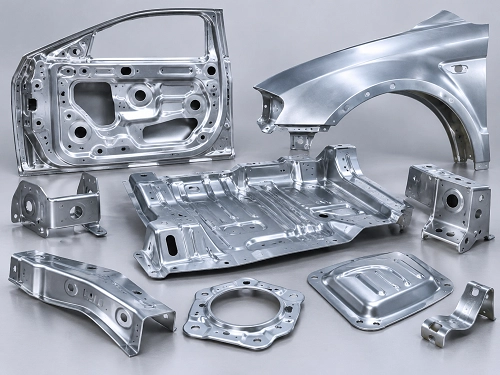

Most problems with custom auto stamping parts trace back to the drawing stage, not the press. A bracket that cracks at a bend, a coated part that no longer fits its mating component, or a tolerance that no one can measure repeatably all start as specification gaps.
It draws on the published capabilities of ACRO Metal Products Ltd., a stamping, welding and assembly manufacturer established in 2003. About half of its products serve the automotive industry, including Tier 1 and Tier 2 customers.
Key takeaways
- Define function first (load, corrosion exposure, mating parts), then choose material and process.
- Set tolerances on the finished, coated part, because coating thickness changes fit.
- Tooling is the largest fixed cost, so lock the design before releasing dies.
- Ask for IATF 16949 certification and a PPAP submission before the first production shipment.
What makes an auto stamping part "non-standard"?
A non-standard (custom-engineered) part is made to your drawing, sample or technical requirements rather than picked from a catalog. In automotive work this usually means one of three things: a geometry that off-the-shelf brackets cannot match, several functions combined into one piece, or a specific load or environmental case. For a general comparison with standard parts, see ACRO's article What Are Non-Standard Stamping Parts? This guide goes further and covers how to specify and validate them.
Step 1: Choose the material by function
Material drives formability, weight, corrosion life and press tonnage. ACRO works with carbon steel, stainless steel (304, 316 and others), aluminum alloys, copper and brass, and specialty alloys, at thicknesses from 0.1 mm to 6.0 mm, with custom ranges available (stamping parts specifications). The table below links each material family to the problem it most often causes and what to put on the drawing to prevent it.
| Material family | Typical automotive use | Main risk to manage | Specify on the drawing |
|---|---|---|---|
| Carbon / cold-rolled steel | Brackets, interior supports, door panels | Rust without protective coating | Coating type, thickness, salt-spray hours |
| High-strength steel (HSLA / AHSS) | Reinforcements, safety-related brackets | Springback, higher press force, tool wear | Grade, yield/tensile range, flatness and angle limits |
| Stainless steel (304, 316) | Exposed clips, heat- or corrosion-exposed parts | Work hardening, galling in the die | Grade, surface finish, passivation requirement |
| Aluminum alloys | Weight-sensitive steps and brackets | Cracking at tight bends, surface scratching | Alloy and temper, minimum bend radius, cosmetic zones |
| Copper / brass | Electrical contacts and terminals | Soft material deforms in handling | Plating (e.g. nickel), contact-area limits |
If weight reduction is the goal, move to high-strength steel or aluminum early. Changing material after tooling is built usually means reworking the die.
Step 2: Match the process and press to the part
ACRO's listed processes are progressive, transfer and compound stamping and deep drawing. A practical way to choose between them:
- Progressive die: best for small to medium parts at steady volume, because the part moves through several stations on a strip and needs little handling.
- Transfer die: better for larger or deeper parts that must be separated from the strip early, with more control over each forming step.
- Deep drawing: for cup or housing shapes. Success depends on material flow and lubrication, so supply the maximum depth and any wall-thinning limit.
- Compound die: suited to flat, high-accuracy blanks where cut features must stay concentric.
Press capacity matters too. ACRO's published press range runs from 80–100 T and 110–350 T up to 500 T, so larger structural parts and high-strength materials can be run in-house. Details are on the product equipment page.
Step 3: Set tolerances that can be measured and held
Published stamping tolerances range from ±0.01 mm to ±0.1 mm, depending on design and material. The tightest values are not a default for every feature. Apply them only where function requires it. Four practices prevent most disputes:
- Tolerance the coated part. Typical coating build-up differs widely: zinc plating is thin, while E-coating and powder coating add more. Where a coated surface mates with another part, state whether dimensions apply before or after coating.
- Define datums by function. Use the surfaces that locate the part in the vehicle, not the ones that are easiest to draw.
- Expect springback on bends, especially with high-strength steel and aluminum. Give angle tolerances a realistic window.
- Mark burr direction and cosmetic zones. A burr on the wrong side can damage seals or wiring.
General design rules of thumb that help formability (confirm each with a DFM review): keep hole diameters at least equal to material thickness, keep holes and slots about 1.5 times thickness from an edge, and avoid bend radii smaller than the material thickness.
Step 4: Plan the surface treatment with the part
For auto stampings, corrosion protection is part of the design. ACRO's surface options include zinc plating, nickel plating, powder coating, anodizing and passivation, and its product range shows E-coated, powder-coated and galvanized parts. Examples include an E-coating panel for an auto door, E-coating brackets for auto interior trim, a powder-coating hook for interior trim, and a powder-coating mudshield and seat for a luxury SUV.
Design details that protect coating quality:
- Add drain and vent holes so liquid does not trap in folds or closed sections.
- Identify hanging or contact points where small bare spots are acceptable.
- Mark threads, ground points and locating holes that must stay uncoated or masked.
- State the corrosion target as a salt-spray duration, not just "corrosion resistant."
Step 5: Make the tooling decision with volume in mind
Dies are the largest fixed cost in stamping. ACRO's own cost analysis explains that this cost is spread across production volume, so unit price falls as volume rises, while small batches stay relatively expensive (Is Metal Stamping a High-Cost Investment?). Practical consequences:
- Prototype before you cut steel. For very small quantities, consider CNC punching and bending to validate fit first. ACRO lists AMADA CNC punching and bending equipment among its machines.
- Freeze the design before die release. Late changes cost far more than changes at the DFM stage.
- Ask who builds the tool. ACRO designs and makes single-station and progressive dies in its own tooling workshop, which keeps design, tooling and production feedback in one team (see advantages).
Step 6: Verify quality with the right evidence
Certification is the starting point. ACRO holds ISO 9001 and IATF 16949, and also lists ISO 14001, ISO 45001, RoHS and REACH. IATF 16949 is the automotive quality management standard, and the Production Part Approval Process (PPAP), developed by the Automotive Industry Action Group (AIAG), is a mandatory requirement under it. PPAP is best seen as evidence that a process can produce conforming parts, not just a pile of paperwork [1].
Ask any supplier for the following before approving production:
- A dimensional report from a coordinate measuring machine (CMM) on first articles.
- Coating thickness and salt-spray test results where corrosion matters.
- Material composition and hardness data for critical parts.
- A control plan that names the in-process checks.
ACRO reports 100% inspection before shipment, using a CMM, salt spray tester, projector, film thickness gauge and tensile tester, and its internal laboratory also covers material composition, hardness and torque testing. See the quality inspection page.
| Area | Published detail |
|---|---|
| Material thickness | 0.1 mm – 6.0 mm (custom ranges available) |
| Dimensional tolerance | ±0.01 mm to ±0.1 mm, depending on design and material |
| Press range | 80–100 T, 110–350 T, 500 T |
| Supply capacity | 300,000 pieces per month; samples in 3–7 days |
| Tooling | In-house design and manufacture of single-station and progressive dies |
| Design software | AutoCAD, Pro-E, Solidworks, UG, CAE analysis |
| Certifications | ISO 9001, IATF 16949, ISO 14001, ISO 45001, RoHS, REACH |
Sample lead time and capacity depend on part complexity and tooling status, so treat these figures as planning guides and confirm them against your drawing.
RFQ checklist: what to send for an accurate quote
- 2D drawing with GD&T and a 3D model; or a sample if no drawing exists.
- Material grade, thickness and any supplier restrictions.
- Annual volume, batch size and expected program life.
- Surface treatment, coating thickness and corrosion-test requirement.
- Critical-to-function dimensions, and which ones need PPAP-level reporting.
- Assembly requirements, if welding or sub-assembly is needed (see welding parts and assembly parts).
Frequently asked questions
Is stamping the right process for my automotive part?
Stamping suits sheet-metal parts at medium to high volume, where tooling cost is spread over many pieces. For a handful of prototypes, laser cutting, CNC bending or machining may cost less overall.
How tight a tolerance should I specify?
Specify tight tolerances only on features that affect fit or function. A tolerance of ±0.01 mm is achievable on suitable features, but applying it everywhere raises tooling and inspection cost without improving the part.
Can the same supplier handle stamping, welding and assembly?
Yes. ACRO manufactures stamped, welded and assembled parts, which reduces hand-offs and keeps tolerance responsibility with one team.
What should I request before approving mass production?
Request first-article dimensional data, test reports for coating and material where relevant, and a PPAP submission at the level your customer requires.