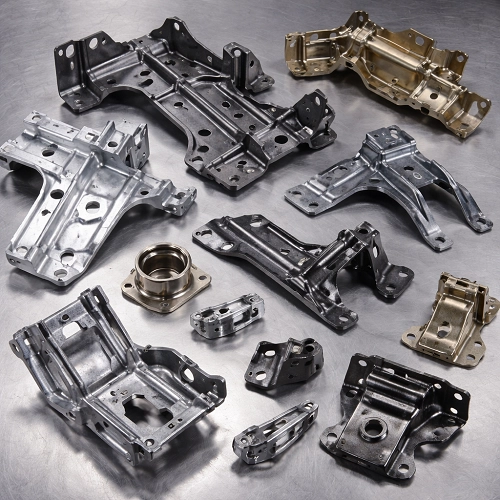
In the highly competitive and constantly evolving automotive industry, non-standard automotive stamping parts play a vital role in enabling manufacturers to meet unique design requirements, optimize performance, and differentiate products. Unlike standard stamping components such as common brackets, clips, and panels, non-standard stamping parts are tailor-engineered to address specific functional, aesthetic, or structural challenges that off-the-shelf components cannot meet.
What Are Non-Standard Automotive Stamping Parts?
Non-standard automotive stamping parts are custom-designed metal components produced through stamping (or pressing) processes but do not conform to widely used, cataloged designs. These parts are engineered to fulfill unique specifications dictated by vehicle OEMs (Original Equipment Manufacturers) or tier suppliers for particular applications.
Key Distinctions from Standard Stamped Parts
| Feature |
Standard Stamping Parts |
Non-Standard Stamping Parts |
| Design |
Generic, widely applicable |
Custom, application-specific |
| Flexibility |
Limited |
High |
| Engineering Requirement |
Minimal |
Complex and detailed |
| Production Volume |
Often large |
Varies widely (prototype to mass) |
| Cost Considerations |
Low unit costs |
Higher engineering and tooling cost |
| Integration with assembly |
Simple interfaces |
Often integrated with multifunction |
Why Automotive Manufacturers Use Non-Standard Stamping Parts
Complex Geometry & Multi-Functionality
Automotive components often need to deliver multiple functions — structural support, load distribution, vibration damping, assembly facilitation, or aesthetic finishes. Non-standard parts can integrate several features in one piece, reducing assembly steps and improving reliability.
Weight Savings & Structural Optimization
Weight reduction is critical for fuel economy and EV range. Stamping allows for controlled deformation and creation of thin-wall, high-strength geometries that provide optimal strength-to-weight ratios.
Tailored Performance for Specific Applications
Components such as unique reinforcement brackets, bespoke chassis stiffeners, and proprietary engine mounting hardware are designed with specific load cases and environmental conditions in mind.
Materials Used in Non-Standard Automotive Stamping
Material selection is a core aspect of design and significantly affects performance, manufacturability, and cost.
Common Materials
Cold-Rolled Steel (CRS)
- Properties: High strength, good surface finish
- Applications: Body panels, structural frames
- Advantages: Uniform properties & predictable behavior
- Limitations: Weight compared to advanced steels
High-Strength Low-Alloy (HSLA) Steel
- Properties: Higher yield strength, improved toughness
- Applications: Safety components, crash-absorbing structures
- Advantages: Weight reduction with maintained safety
- Limitations: Requires precise tooling and control
Advanced High-Strength Steels (AHSS)
- Examples: Dual-phase (DP), Transformation-Induced Plasticity (TRIP), Martensitic steels
- Advantages: Exceptional strength & ductility
- Limitations: Difficult to form without advanced tooling
Aluminum Alloys
- Properties: Lightweight, corrosion resistant
- Applications: Body panels, engine/powertrain brackets
- Advantages: Significant mass savings
- Limitations: Different forming techniques than steels
Stainless Steel & Specialty Alloys
- Properties: Corrosion resistance, heat tolerance
- Applications: Exhaust components, chassis elements exposed to environment
Manufacturing Processes for Non-Standard Parts
Progressive Die Stamping
In progressive die stamping, a metal strip passes through multiple stations in a stamping press. Each station progressively shapes the part — cutting, bending, punching, and forming the component in a single progressive motion.
- Benefits: High throughput, repeatability, minimal handling
- Best for: High-volume production where part geometry permits
Transfer Die Stamping
In transfer die stamping, individual blanks are mechanically transferred between stations, allowing for more complex forming sequences with greater control.
- Benefits: Supports deeper draws and tighter tolerances
- Best for: Mid- to high-volume, complex geometries
Deep Draw Stamping
Used for forming parts with high depth-to-diameter ratios without cracks or defects.
- Uses: Fuel tanks, deep housings
- Challenges: Controlling material flow and lubrication
Hot Stamping / Press Hardening
In hot stamping, heated blanks are formed and rapidly cooled to achieve ultra-high strength.
- Advantages: Enables AHSS with extreme strength
- Applications: Reinforcement beams, crash structures
Design Considerations in Non-Standard Stamping
Formability & Material Limits
Understanding material formability limits is essential — too complex a shape may exceed material elongation limits, causing cracks or splits.
- Finite Element Analysis (FEA) is used to predict forming behavior.
- Blank holding force, die profile, and lubrication are tuned to prevent defects.
Tolerances & Precision
Non-standard parts often require tighter tolerances due to assembly constraints.
- GD&T (Geometric Dimensioning and Tolerancing) ensures consistency across batches.
- Advanced in-die sensing can monitor quality in real time.
Tooling Design
High-precision tooling is critical:
- Tool set wear and maintenance directly impact part quality.
- Modular tooling offers flexibility for design iterations.
Quality Assurance & Inspection
To ensure reliability, non-standard parts undergo stringent inspection protocols:
- In-process gauges and sensors for immediate feedback
- Coordinate Measuring Machines (CMM) for geometry verification
- Non-destructive testing (NDT) such as ultrasonic inspection for internal integrity
Comparison with Alternative Manufacturing Methods
| Criterion |
Stamping |
Casting |
Machining |
Additive Manufacturing |
| Complexity of Geometry |
Moderate to High |
High |
Very High |
Very High |
| Material Utilization |
Excellent (Low Wastage) |
Moderate |
Poor (High Wastage) |
Excellent |
| Production Volume Efficiency |
Excellent (High Volumes) |
Good (Medium to High Volumes) |
Poor (Low Volumes) |
Good (Prototyping / Low Volumes) |
| Cost per Part (High Volume) |
Low |
Moderate |
High |
High |
| Mechanical Properties |
Excellent (work-hardened) |
Good to Excellent |
Excellent |
Variable |
| Lead Time |
Moderate (tooling heavy) |
Long (mold setup) |
Short to Moderate |
Short |
Stamping vs Casting
- Stamping excels with sheet metal parts where thin-wall precision is essential.
- Casting is preferable for complex 3D shapes with internal cavities but may require secondary machining.
Stamping vs Machining
- Stamping yields faster throughput and better material utilization.
- Machining is better for low-volume, high-precision components but suffers from high cost and material waste.
Stamping vs Additive Manufacturing
- Additive offers unmatched design freedom and rapid iteration for prototypes or low runs.
- Stamping outperforms in cost and speed for mass production.
Applications of Non-Standard Automotive Stamping Parts
- Crash management systems: Custom reinforcements and rails
- Chassis components: Tailored brackets and cross-members
- Powertrain supports: Unique mounts and housings
- Body-in-White (BIW): Specialized reinforcements and interface parts
- Interior structural supports: Frames and brackets with integrated features
Challenges and Future Trends
Industry Challenges
- Balancing cost with customization
- Tooling lead times for unique parts
- Material limitations affecting formability
- Increasing regulatory demands (safety & emissions)
Emerging Trends
- Integration of simulation and AI for design optimization
- Hybrid manufacturing (stamping + additive)
- Use of ultra-lightweight materials (e.g., magnesium alloys)
- In-die sensors and digital twins for quality control
Non-standard automotive stamping parts represent an essential segment of automotive manufacturing, enabling custom performance, structural integrity, and production efficiency where standard parts fall short. From material selection and tooling design to advanced manufacturing methods and inspection systems, the engineering behind these components is complex and highly specialized.